Emergency preparedness · Rural health clinic edition
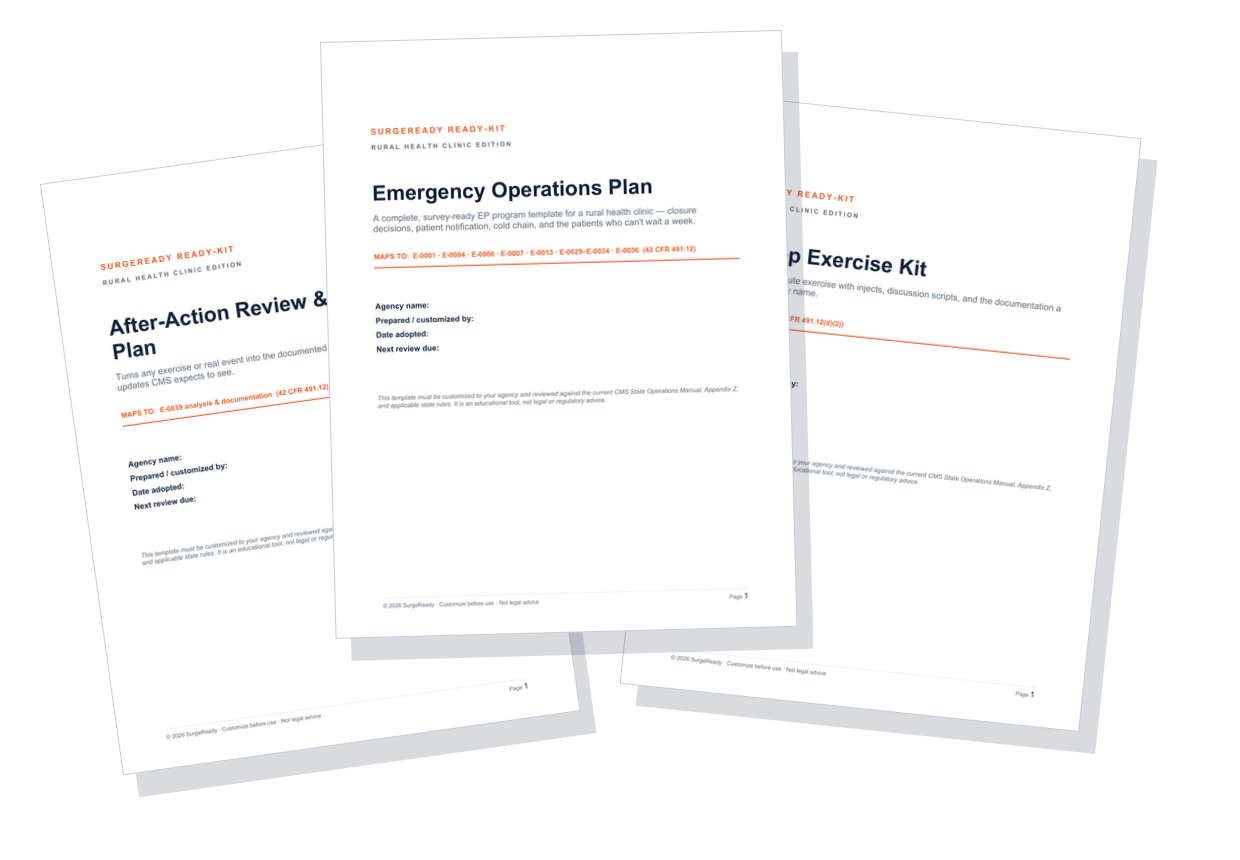
Every certified rural health clinic must maintain an emergency preparedness program — plan, risk assessment, staff training, and an annual exercise with a written after-action review. This kit is all of it: six editable Word documents built for a small clinic an entire community depends on, mapped tag-by-tag to what the surveyor checks.
The problem
Appendix Z was written for hospitals — then applied to clinics where one closure decision affects a whole town. These are the tags that turn into deficiency citations on survey day:
Surveyors want a facility- and community-based, all-hazards assessment — current, scored, and signed, reflecting your county's actual hazards and your clinic's role in them.
One exercise every year, with a written after-action review. The ice storm you closed for last winter only counts if somebody documented the decisions.
"Who decides to close, how do patients find out, and what happens to the vaccines?" If the answer lives in one person's head, it isn't a policy — and surveyors know it.
What's inside
Each template is written specifically for clinic care — closure playbooks instead of bed counts, cold-chain procedures instead of overhead pages — and states the E-tag it satisfies.
Scored hazard worksheets, top-five summary, and the service-continuity snapshot — visit volume, high-dependency panels, cold-chain inventory, telehealth reach.
The flagship: closure decisions and notification, continuity priorities for patients who can't wait a week, cold-chain procedures, and the communication plan.
Initial and biennial rosters, a training outline covering closure communication and the cold chain, and a 10-question knowledge check with answer key.
A facilitated 90-minute scenario — ice-storm closure with a 3 a.m. vaccine-fridge failure — with sign-in sheet and documentation form.
The form that turns any exercise or real event into the analysis and corrective actions CMS expects to see.
Eight tabs, the questions clinic surveyors actually ask, and a 30-day countdown that makes survey week boring.
Not a 300-page manual. Every document is built to be completed, signed, and put in a binder — because a plan that exists is worth more than a plan that impresses.
How it works
Replace the bracketed placeholders with your clinic's details, score your hazards, and complete the continuity snapshot. Everything is plain Word — no software to learn.
Run the 30-minute staff training from the outline, then the 90-minute tabletop with your team. Sign-in sheets and documentation forms are included.
Eight tabs, everything current and signed. The surveyor's emergency-preparedness review becomes a ten-minute conversation.
"I built this kit because the Emergency Preparedness Rule holds a three-provider clinic to the same standard as a hospital system — without giving it any of the tools. You shouldn't need a consultant retainer to prove your community still gets care when the roads ice over. You need documents that are already 90% written, that a surveyor recognizes on sight."Dr. Arzoo Salami — practicing physician & founder, SurgeReady
Get the kit
Rural health clinic edition
$299 one-time
30-day guarantee: if your administrator doesn't think it will survive a survey, reply to your receipt for a full refund.
By purchasing you agree to the Terms of Service. The kit is a set of professional templates — not legal or regulatory advice — and must be customized to your organization. No survey outcome is guaranteed.
Free sample
Download the All-Hazards Risk Assessment Worksheet — a complete document from the kit, free. It's the page E-0006 citations hinge on, and the fastest way to judge whether the rest is worth $299.
Download the worksheet — free (PDF)✓ On the list — and your worksheet download has started.
Free. We'll send occasional SurgeReady updates — unsubscribe anytime. The complete six-document kit is available on this page.
Other facility types
The Emergency Preparedness Rule covers seventeen provider types — and a surgery center's emergency is nothing like a home health agency's. Each edition is rewritten for its care model: what the surveyor checks, what your staff actually do, and the exercise that fits your day.
Home-based patients, classification rosters, field staff — the original edition of the kit.
See the edition — $299Home- and facility-based patients, comfort-kit continuity, volunteers, on-call guidance for families — including a death during the emergency.
See the edition — $299Patients under anesthesia when the power fails: complete-vs-abort decisions, PACU transfer, tracking, closure and verified reopening.
See the edition — $299MCI surge, mutual aid, recall tiers, and sustained storm operations — in the HSEEP format coalitions, states, and grant reviewers expect.
See the edition — $299The inpatient rule in full: two exercises a year, subsistence math, emergency power documentation, patient tracking, and the evacuate-vs-shelter decision.
See the edition — $299Beyond the binder · SurgeReady Software
Templates make you survey-ready. The software runs the drill itself: evaluators tap observations on phones, command watches live, and the HSEEP After-Action Report writes itself the moment you close the exercise. Founding-agency pilot now open.
Questions
The kit is built on the federal requirements (42 CFR §484.102 and Appendix Z) that every state surveyor applies. Some states add requirements on top — the EOP includes a section to record yours, and the checklist prompts you to verify state rules during customization.
A documented real activation counts — it exempts you from the next required full-scale exercise for one year, if you wrote it up. The After-Action Review form in the kit is exactly that documentation.
No. $299 once, files are yours forever, and updates for CMS revisions are included by email.
Editions exist for home health agencies (42 CFR §484.102), hospices (§418.113), ambulatory surgery centers (§416.54), rural health clinics (§491.12), critical access hospitals (§485.625), and EMS agencies (HSEEP-framed) — see "Other facility types" above. Run more than one provider type? Email us about a bundle.
No. It's a professionally drafted documentation starting point that you customize and your leadership adopts. Regulations change — verify current requirements, and consult counsel for legal questions.